


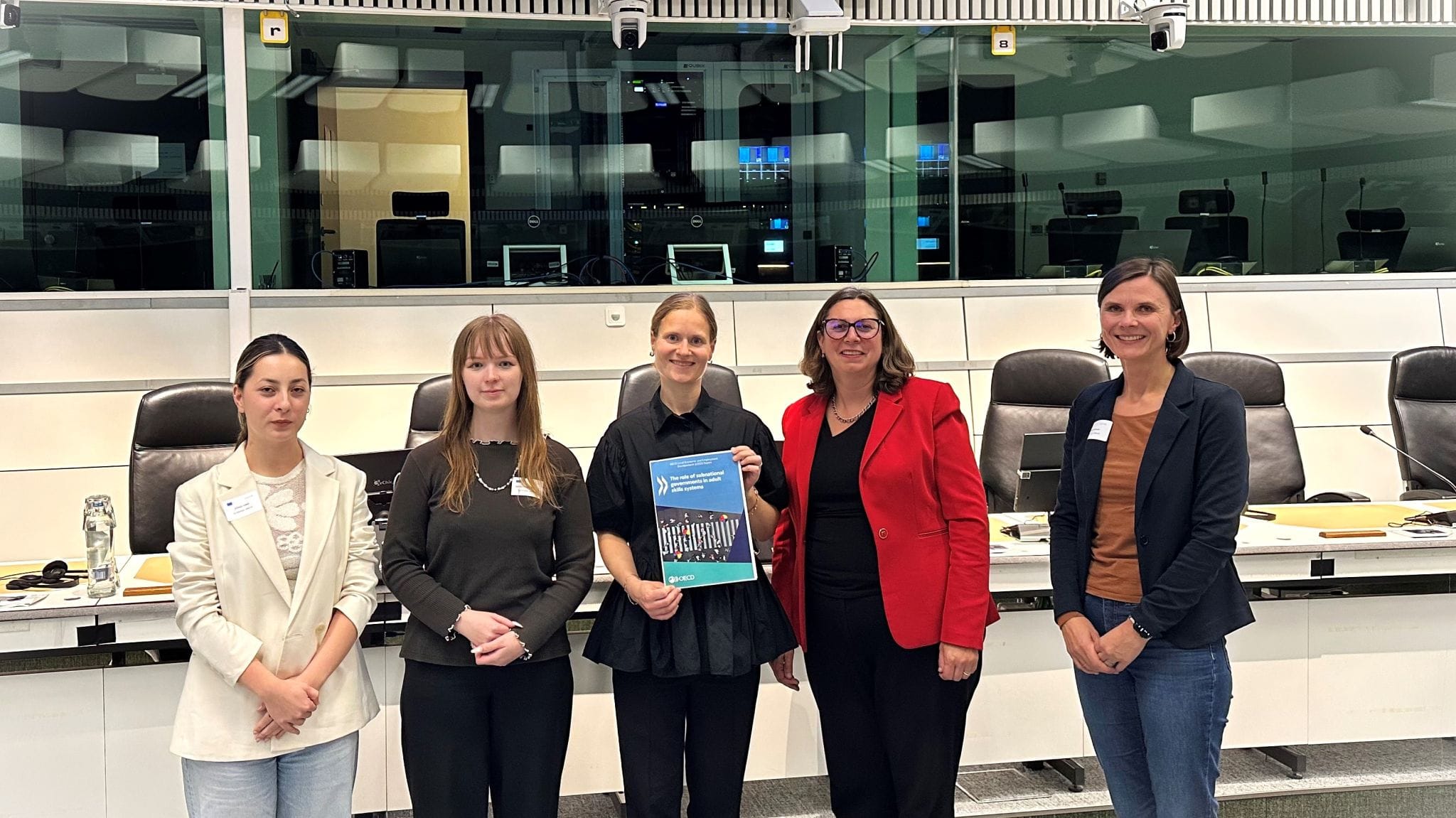
WAPES Secretariat, together with Tilde Ussing and Karen Maguire from OECD, attending the conference launching the OECD policy paper. (Persons from left to right: Nino Zoidze, Emma Monster, Tilde Ussing, Karen Maguire and Nicole Clobes)
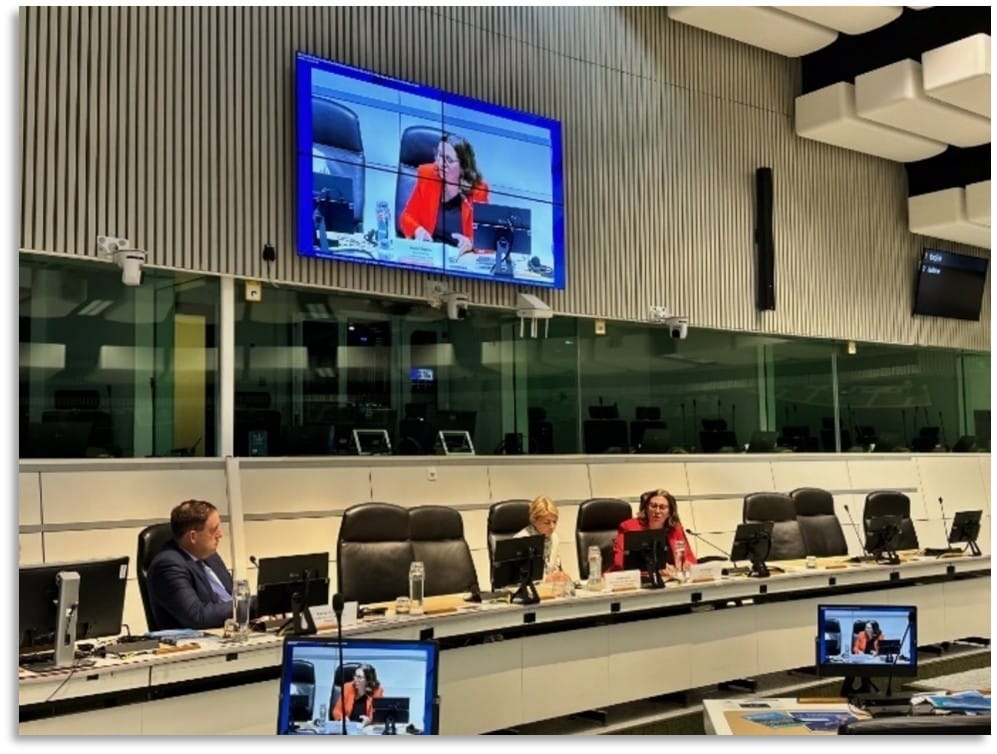
Karen Maguire presenting on behalf of OECD during the conference. (Persons from left to right: Kieran McCarthy (CoR, Member & Cork City Council, Councillor), Tanya Hristova and Karen Maguire)
Report: The Role of Subnational Governments in Adult Skills Systems | CoR (Committee of the Regions) & OECD (Organisation for Economic Co-operation and Development) | 1 October 2025
Opening Remarks
The importance of investing in adult skills has never been more critical. Rapid changes in labour markets, driven by technological advancements such as AI, green economies, and political uncertainties, are reshaping the demand for skills across Europe. Subnational governments, cities and regions, are at the forefront of addressing these challenges, playing a central role in financing, delivering, and tailoring skills policies to local needs. This report synthesizes insights from a high-level panel discussion involving key institutions and local leaders, emphasizing the necessity of integrated partnerships and flexible, place-based approaches.
Main Report Highlights, as presented by Tilde Jacobsen (OECD, Policy Analyst), Karen Maguire (OECD, Senior Counsellor) and Tanya Hristova (SEDEC Commission, First Vice Chair & Mayor of Gabrovo Municipality).
The Urgency of Skills Investment
• Skills shortages and labour market shifts are now a top priority, with three-quarters of small businesses citing lack of skills as a major challenge.
• Adult learning is not only about labour markets but also about addressing broader societal challenges, including innovation bottlenecks and social cohesion.
The Central Role of Subnational Governments
• Subnational governments are uniquely positioned to design and implement skills policies that reflect local realities. Their proximity to businesses, training providers, and citizens fosters trust and enables tailored solutions.
• Governance models vary: centralised, combined, or decentralised. The effectiveness of each depends on local context and the ability to adapt to regional differences.
Key Challenges
• Resource Adequacy: Subnational governments often lack sufficient resources to meet growing skills demands. • Data and Coordination: There is a need for better data collection and sharing between local, regional, and national levels to inform policy and prevent duplication. • Mobility and Inclusion: Ensuring equal access to training and mobility opportunities, especially for low-qualified workers and vocational students, remains a persistent challenge. • Institutions and Their Roles
OECD is at the forefront of research into the topic of skills, publishing this report highlights in particular policies to support disadvantaged places and people, such as the low skilled, the unemployed, migrants, youth and seniors. Subnational governments play a central role in in labour market outcomes; strong local governments facilitate collaboration. Bottom-up and top-down approaches are essential.
While several organisations from within the EU were present during this conference we were especially impressed by the work that has been done by EuroCities. Nathalie Guri, Projects & Knowledge Sharing Director at Eurocities, emphasized that active engagement with local businesses and collaboration with educational institutions are essential for cities seeking to foster sustainable economic development. Cities must prioritize the collection of ground-level data from businesses, using these insights to inform targeted policies and training programs. Investing in peer learning and capacity building is also critical, as these approaches enable cities to share best practices, avoid repeating past mistakes, and build resilience for the future.
WAPES’ member from Wallonia, Belgium, Le Forem, was also in attendance. Yves Magnan (Director General) presented a best-practice example on the topic of Vocational Education and Training (VET). Le Forem offers apprenticeships, operating from 22 Competence Centres, across more than 50 training sites with approximately 750 internal trainers. VET in Wallonia is aiming to become an attractive partner for jobseekers, particularly when it comes to the inclusion of vulnerable groups. Therefore, Le Forem is closely collaborating with job seekers to better identify and support these vulnerable groups.
________________________________________
Conclusions
Call to Action
• Strengthen Multi-Level Governance: Ensure coordination between EU, national, and subnational levels, with flexibility for local adaptation.
• Invest in Resources and Data: Provide adequate funding and improve data collection to inform evidence-based policy.
• Promote Inclusion and Mobility: Public services should actively address barriers to training and mobility, especially for low-qualified and vocational learners, while effectively supporting vulnerable groups.
• Foster Peer Learning: Encourage knowledge-sharing among regions to avoid repeated mistakes and build capacity.
Final Thought
The skills challenge is real and urgent, particularly at the local level. Subnational governments, in partnership with the OECD, CoR, EU, and WAPES, must lead the way in designing inclusive, responsive, and innovative skills systems that meet the needs of today’s and tomorrow’s labour markets.