
Launch of SamPES 2.0: a pan-African methodology based on the realities of African labour markets
SamPES: A self-assessment method for public employment services
Public employment services (PES) in Africa cannot be effectively reformed on the basis of models designed for other contexts. Widespread informality, discontinuous career paths, limited statistical coverage and the regional variation in employment and skills dynamics are structural characteristics of African labour markets that require a tailored response.
On this basis, the WAPES network is officially launching the project to overhaul its approach to the evaluation and strengthening of public employment services: SamPES 2.0. This new version is not merely a technical update, but a systemic reform, designed on the basis of an in-depth analysis of the situation in Africa.
Why revamp SamPES? The reality of African labour markets as a starting point
In sub-Saharan Africa, over 80% of non-agricultural employment is in the informal sector (ILO, 2020). Career paths are highly diverse: self-employment, informal entrepreneurship, rural pathways and seasonal mobility. The digital and green transitions are accelerating these changes. Public employment services are no longer limited to formal job placement; they must become key players in providing comprehensive support for economic pathways.
In the Maghreb, other characteristics prevail: high unemployment among graduates, low female labour force participation rates and a persistent informal economy, but also more institutionalised public employment services (ANAPEC, ANETI, ANEM, TECHGHIL) which bring valuable expertise in results-based management and information systems.
These two sub-regions face common challenges: the inadequacy of traditional indicators, the need to integrate the informal economy, gender inequalities and demographic pressure from the young population. They also exhibit significant structural differences. These similarities and differences outline the contours of a relevant and urgent South-South cooperation, which WAPES aims to systematise within the framework of SamPES 2.0.
Thierry Huort
📖 For further information: the Africa Dossier
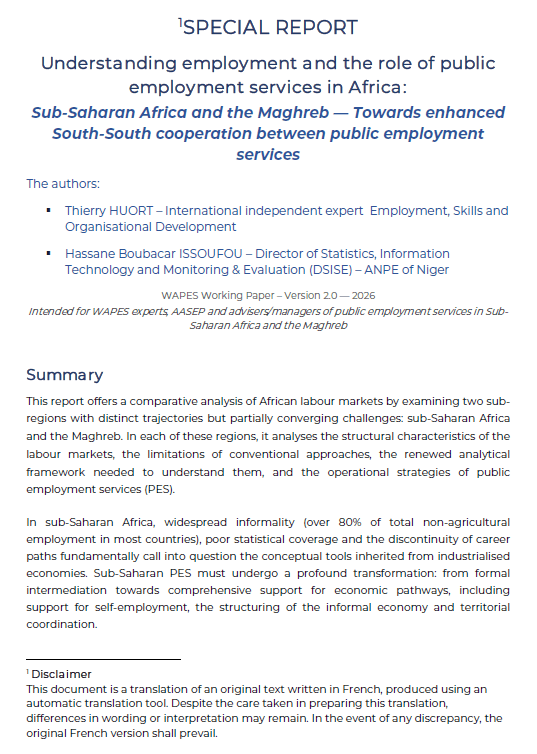
This article is based on the analyses presented in the WAPES report: ‘Understanding Employment and the Performance of Public Employment Services in Africa – Sub-Saharan Africa and the Maghreb – Towards Enhanced South-South Cooperation between Public Employment Services’ (WAPES Working Paper, Version 2.0 – 2026). This report provides a comparative analysis of the labour markets in both sub-regions and advocates for greater peer-to-peer technical cooperation between public employment services in the Maghreb and those in sub-Saharan Africa..