


Article written by Emma MONSTER, WAPES Consultant
Seminar report | ILO seminar | Trade and Labour in Uncertain Times – Shaping Africa’s Future in the Global Economy
3 March 2026
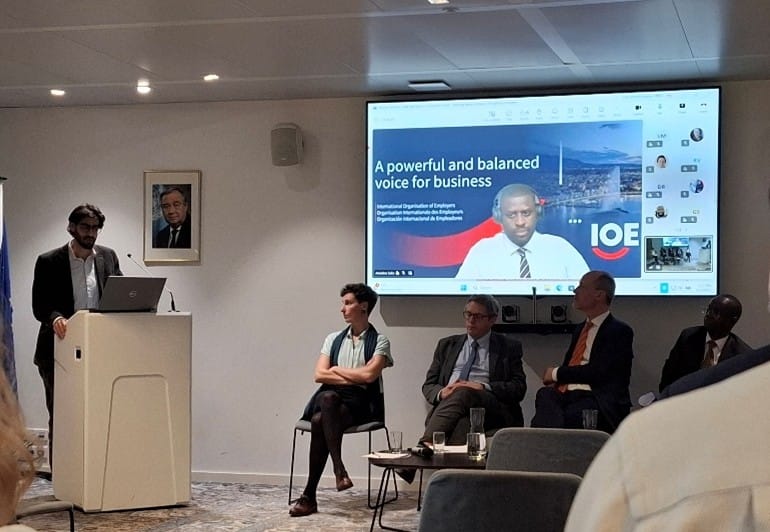
Diego López González provides comments on the seminar. (Persons sitting from left to right: Giulia Baconcini, Axel Marx, Jörg Wojahn, Daniel Tanui. On the screen: Amadou Sako.)
Aim of the seminar
The seminar aimed to explore how African governments, institutions, employers’ and workers’ organisations, and development partners can leverage trade to advance decent work and support long-term sustainable growth.
Discussions focused particularly on how trade policy, labour standards, and development cooperation can be better aligned to ensure that trade contributes to inclusive growth and improved working conditions across Africa.
The seminar brought together representatives from UN agencies, trade unions, the Government of Flanders, research institutions, and NGOs.
List of speakers
- Carlien van Empel – Director, ILO Brussels (facilitator)
- Fanfan Rwanyindo Kayirangwa – ILO Regional Director for Africa
- Jan Wouters – Director, Leuven Centre for Global Governance Studies
- Caroline Fredrickson – Director, ILO Research Department
- Marva Corley-Coulibaly – Senior Economist, ILO Research Department
- Ambassador Daniel Tanui – Deputy Head of Mission, Embassy of Kenya in Brussels
- Jörg Wojahn – Head of Unit Bilateral Relations in Trade and Sustainable Development, European Commission DG Trade
- Axel Marx – Deputy Director, Leuven Centre for Global Governance Studies
- Giulia Baconcini – Senior Environmental and Social Officer, BIO (Belgian Investment Company for Developing Countries)
- Amadou Sako – Senior Adviser, International Organization of Employers (IOE)
- Diego López González – Policy Coordinator, Economic and Social Policy, International Trade Union Confederation (ITUC)
Opening remarks
The seminar opened with remarks highlighting the role of trade in advancing human rights and supporting development in Africa. (Fanfan Rwanyindo Kayirangwa) It was noted that labour and trade have become central topics in global governance debates. Africa remains relatively marginalised in the global economy, while demographic change, informality, and youth unemployment continue to constrain growth. Aligning labour, trade, and investment policies will be essential to support structural transformation and expand intra-African trade. (Jan Wouters)
Presentation of the draft report
The seminar presented the draft report titled Engaging Stakeholders in Trade and Investment Arrangements to Promote Decent Work in Africa, based on stakeholder surveys carried out in Tanzania, Burundi, Kenya, Rwanda, and Uganda. This research is part of the ILO IMPLEMENT Project, which falls under the Integrating Trade and Decent Work Programme (INTEGRATE), funded by the European Union and the Government of Flanders.
Respondents generally saw trade as a catalyst for human development, particularly through skills development and job creation. However, challenges remain, including poor working conditions, the dominance of small, often rural, family farms in agriculture, limited resources for policy implementation, and gaps in labour law enforcement. Stakeholders highlighted the need for stronger engagement among governments, employers, workers’ organisations, and other actors. (Marva Corley-Coulibaly)
Trade-related jobs are generally more likely to provide decent work, yet Africa currently has the lowest share of such jobs globally. Regional trade remains limited, and many African economies continue to depend heavily on external partners, particularly in Europe. (Caroline Fredrickson)
Main challenges
- Amadou Sako identified structural challenges that limit the ability of trade to generate decent work in Africa: informality, low and uneven productivity and skills mismatches.
- Axel Marx added that there is a lack of a clear academic consensus on how labour rights should best be prioritised or enforced.
o Labour rights provisions are broad and may require prioritisation.
o Enforcement mechanisms remain relatively weak.
o Limited resources and institutional capacity hinder implementation.
o It remains unclear whether sanctions or positive incentives are more effective in fostering compliance.
- Giulia Baconcini added that regulatory compliance requirements can place a heavy burden on smaller companies, particularly those in remote areas with limited access to expertise or consultancy services.
Main priorities
- Trade, employment, and skills policies need to be better aligned to ensure that trade expansion translates into quality job creation.
- Vulnerable sectors and workers—particularly those in agriculture—require targeted support.
- Social dialogue should be strengthened so that governments, employers, and workers can anticipate the labour market impacts of trade and manage transitions more effectively.
- Labour standards within trade frameworks must be implemented effectively and supported by strong institutions. (Marva Corley-Coulibaly)
Additional proposals included developing roadmaps to prioritise key labour rights, introducing rapid response mechanisms to address breaches more effectively, strengthening partnerships to build capacity, and considering tariff differentiation linked to labour standards as a possible incentive mechanism. (Axel Marx) Trade agreements alone cannot solve these challenges. (Jörg Wojahn) Overall, the seminar highlighted that trade has significant potential to support the advancement of decent work in Africa, but a significant amount of work will have to be done in order to realise this potential.
Relevance for PES
Since Public Employment Services (PES) were not mentioned during the seminar, I approached Giulia Baconcini after the session. She explained that neither she nor the rest of BIO had ever engaged with PES. Based on her observations, PES mainly serve people with degrees living in urban areas. People living in rural areas, particularly those working in informal jobs in the agricultural sector, generally do not use PES or are unable to benefit from them.
However, she expressed strong interest in the idea of working with PES and indicated that this could represent a promising opportunity for collaboration in the future.
African PES could play an important role in helping workers move from informal to more formal and stable employment. As trade and investment expand, PES may help anticipate labour market shifts by supporting workers in sectors undergoing transformation, particularly in sectors such as agriculture.
Furthermore, strong global PES systems can help ensure that the benefits of trade are more widely shared by improving access to employment services, supporting upskilling and reskilling, and strengthening labour market resilience. Furthermore, the discussions on stakeholder engagement highlight the importance of involving labour market institutions, including PES, in broader policy dialogues related to trade, employment, and social development.